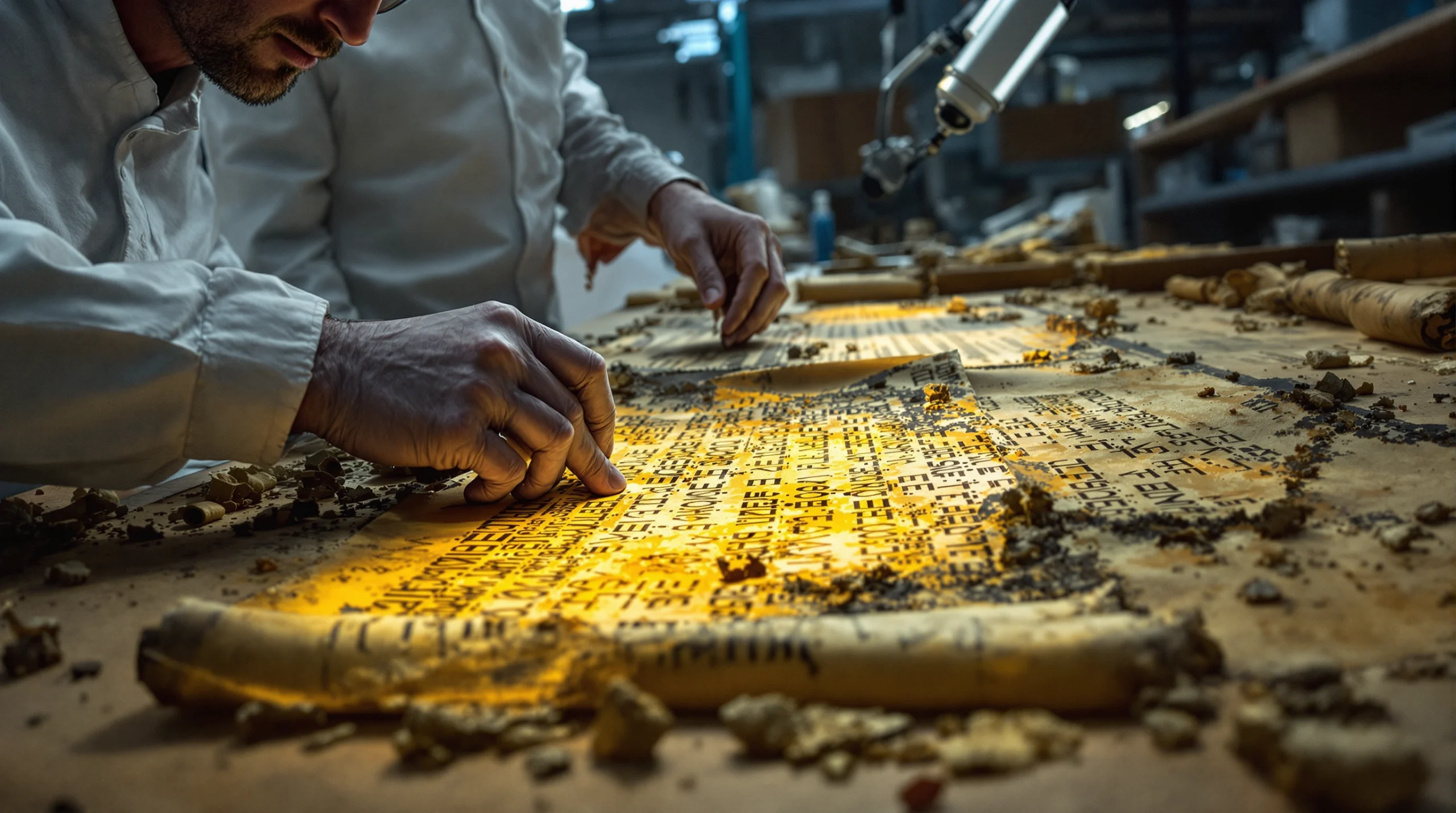
AI Tools: Decoding Ancient Scrolls with Modern Technology
AI tools are revolutionising how we uncover ancient history. The recent breakthrough with the Herculaneum scrolls has archaeologists, historians, and tech enthusiasts buzzing with excitement.
Let me share what’s happening in this fascinating intersection of cutting-edge technology and ancient mysteries.
What is the Vesuvius Challenge?
The Vesuvius Challenge is a global initiative where scientists and researchers use AI tools to decipher charred scrolls buried during the eruption of Mount Vesuvius nearly 2,000 years ago.
Led by computer scientist Brent Seales, this project brings together experts from various fields with one goal: making these ancient texts readable again without physically unrolling them.
The scrolls were discovered in a villa in Herculaneum, a town near Pompeii that was buried when Mount Vesuvius erupted in 79 CE. For centuries, these papyri have remained unreadable due to their fragile, carbonised state.
Using advanced AI imaging techniques, researchers have begun to reveal text that’s been hidden for millennia.
How Are AI Tools Reading These Ancient Scrolls?
The process involves several sophisticated AI tools working together:
- High-resolution X-ray imaging at the Diamond Light Source facility
- Machine learning algorithms that detect ink patterns within the charred material
- Virtual unrolling technology that creates digital versions of the scrolls
The AI doesn’t just scan the surface. It penetrates the layers, identifying the slight density differences between ink (which contains metal) and papyrus.
So far, researchers have managed to read several Greek words, including “porphyras” (purple) and “disgust” – small victories that promise greater discoveries ahead.
This innovative approach to archaeology shows how AI tools can solve problems that seemed impossible just a decade ago.
Why Can’t We Just Unroll the Scrolls Physically?
These scrolls are extremely fragile – they’re essentially carbonised by the volcanic heat. Any attempt to physically unroll them would destroy them instantly.
Previous attempts in the 18th century resulted in scrolls crumbling to dust. Today’s non-invasive AI tools allow us to “read” the text without touching the scrolls at all.
This preservation-friendly approach could be applied to countless other fragile historical documents around the world.
What Have We Learned So Far from the Scrolls?
While we’re still in the early stages, researchers have already deciphered several words and partial sentences in ancient Greek.
Many of the scrolls appear to contain philosophical texts, possibly from the Epicurean school of thought, which was popular in the region.
Each new word revealed gives us a direct connection to the ancient world – thoughts written down before Mount Vesuvius buried them in ash.
For businesses interested in cutting-edge AI technologies, tools like AdCreative.ai are bringing similar innovation to marketing and design. This platform uses AI to generate creative advertising solutions, much like how researchers are using AI to reveal ancient text.
Who’s Behind the Vesuvius Challenge?
The project brings together an impressive collection of minds:
- Computer scientists specialising in machine learning
- Papyrologists who study ancient documents
- Classical historians who provide context
- Imaging specialists who perfect the scanning techniques
This collaborative approach shows how AI tools work best when combined with human expertise across multiple disciplines.
Funding comes from research grants and private donors interested in both technological advancement and historical preservation.
What Other Ancient Mysteries Could AI Tools Help Solve?
The techniques developed for the Vesuvius scrolls could help with:
- The Dead Sea Scrolls – revealing faded text
- Palimpsests – manuscripts where text was scraped off and written over
- Water-damaged documents from shipwrecks
- Faded inscriptions on monuments and buildings
The possibilities are endless. Each success builds upon the last, refining AI tools for historical research.
What Are the Challenges Still Facing the Project?
Despite the impressive progress, significant hurdles remain:
- Image resolution needs further improvement
- Many scrolls are severely damaged
- Translating ancient Greek requires specialists
- Processing the vast amount of data takes time
The team continues to enhance their AI tools and methodologies, learning from each small victory.
How Can I Follow or Support the Vesuvius Challenge?
If you’re fascinated by this blend of ancient history and modern AI tools:
- Follow updates on the official Vesuvius Challenge website
- Watch for published papers in journals like Nature and Science
- Support organisations funding digital archaeology
- Share information about the project to raise awareness
For businesses looking to harness AI in their own work, tools like AdCreative.ai offer accessible ways to experience the power of artificial intelligence in creative processes.
What Does This Mean for the Future of Historical Research?
The Vesuvius Challenge represents a new chapter in how we study the past. AI tools aren’t replacing historians – they’re giving them unprecedented access to sources previously thought lost forever.
This marriage of technology and history creates opportunities for discoveries that could rewrite our understanding of ancient civilizations.
As AI tools continue to develop, we can expect more breakthroughs in reading damaged, faded, or otherwise inaccessible historical texts.
The future of archaeology will increasingly involve collaboration between AI specialists and historians, each bringing their unique expertise to solve ancient mysteries.
From the carbonised scrolls of Herculaneum to countless other untapped sources, AI tools are helping us reconnect with our past in ways previously unimaginable.
Written by Hayley Brown, owner of allin1app.com, lover and obsesser of all things AI and automation and provides significant added value for readers including how to set up time saving automations using https://www.make.com/en/register?pc=hayleyallin1