How’s AI Changing the Virtual Production Game? Expert FAQs Answered
How’s AI changing the virtual production game? This question keeps popping up in film and TV production circles. The technology that once seemed futuristic is now becoming standard practice, with studios like Dimension leading the charge in incorporating artificial intelligence into their workflows.
What Exactly is Virtual Production?
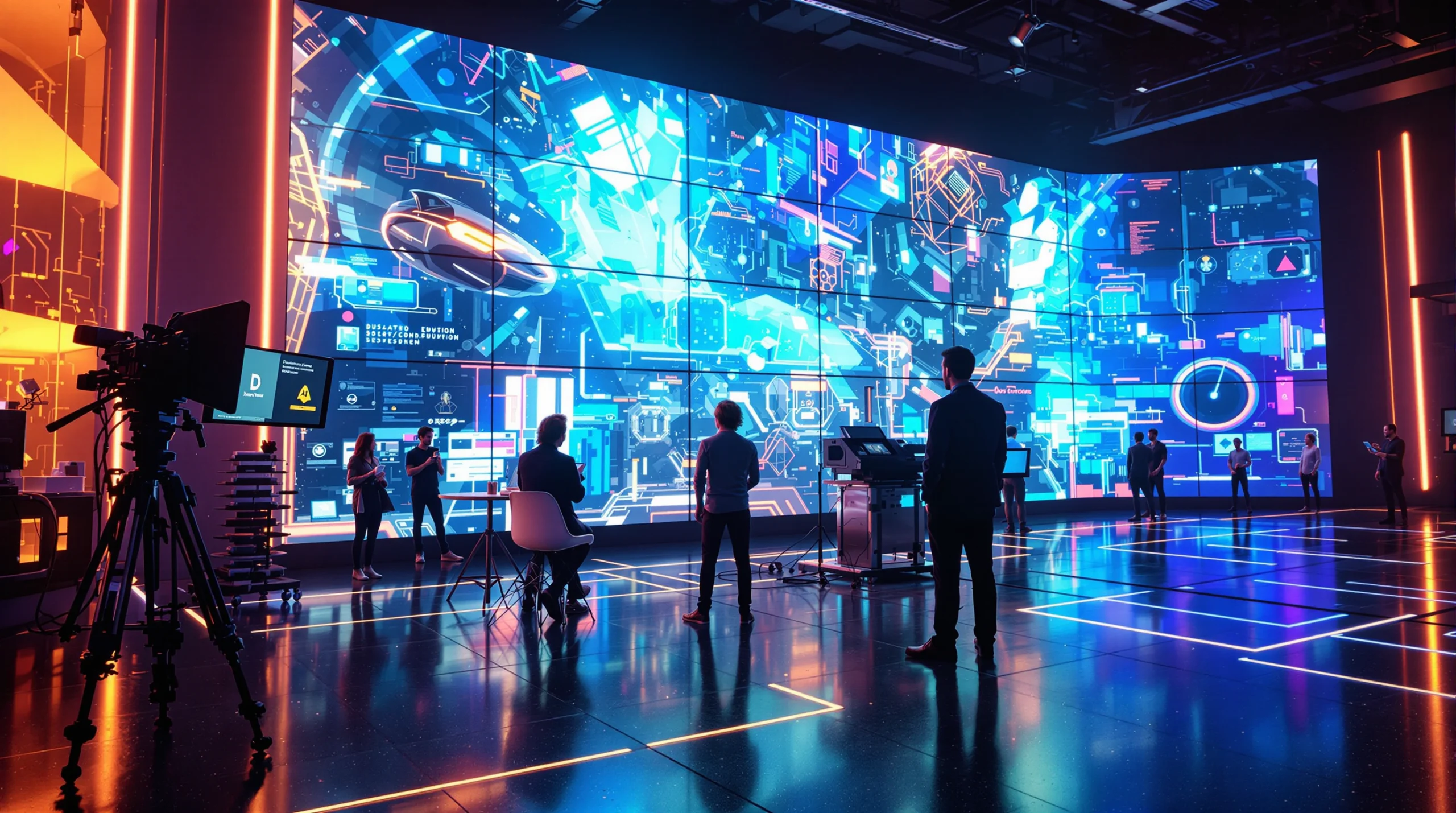
Virtual production combines physical filming techniques with digital creation methods in real-time. Think of those massive LED walls showing fantastical backgrounds while actors perform in front.
It’s not just about fancy visuals – it’s a complete reimagining of the production pipeline.
The traditional method forced filmmakers to visualise scenes, film against green screens, and wait months for VFX teams to work their magic.
With virtual production, what you see on set is essentially what you get in the final cut – immediate visual feedback that saves time and money.
How is AI Enhancing Virtual Production Specifically?
AI tools are revolutionising several aspects of virtual production:
- Real-time rendering improvements (scenes look finished while filming)
- Smart camera tracking systems that adjust automatically
- Automated rotoscoping and scene analysis
- Character animation assistance that speeds up workflow
- Background generation that once took weeks now happens in hours
I’ve seen teams navigate the ethical considerations of using AI in creative fields. The technology isn’t replacing human creativity but amplifying what’s possible within tight schedules and budgets.
What Makes Dimension Studio’s Approach Unique?
Dimension Studio has positioned themselves as accessibility champions in the virtual production space. They’re not just serving the Hollywood elite – they’re making these tools available across industries.
Their integrated approach to AI doesn’t treat it as a separate element but weaves it throughout the production process.
For example, their animated short “Mara & Milo: Magic & Mystery” demonstrates how AI contributes to storytelling elements, not just technical wizardry.
Through their partnership creating DNEG 360, they’ve built a system where visualization, content creation, and virtual production operate as a unified workflow rather than siloed departments.
What Real-World Projects Showcase This Technology?
Dimension has applied their AI-powered virtual production techniques to “Those About to Die,” creating detailed environments with Unreal Engine.
The use of LED volumes allows them to capture final-quality footage in-camera – what you see through the viewfinder is remarkably close to the finished product.
This approach made headlines when “The Mandalorian” pioneered it on a large scale, but Dimension has refined the process with AI assistance that makes adjustments faster and more accurately.
How Do Production Teams Collaborate with AI Tools?
Collaboration remains central to successful virtual production, even with AI in the mix.
Dimension utilises source control software like Perforce Helix Core to maintain version control across teams working simultaneously on different elements.
The learning curve for these tools is steep, but Dimension has made training and knowledge-sharing a core part of their operation.
The result is that artists, technicians, and directors can speak the same language when discussing both creative and technical challenges.
For businesses looking to streamline their communication processes alongside their production workflows, tools like EZMessenger AI provide AI-powered messaging solutions that integrate with existing systems – a helpful complement to the production technology itself.
What Problems Does AI Solve in Virtual Production?
AI tackles several longstanding challenges in production:
- Budget constraints – by reducing post-production time and reshoots
- Time efficiency – through automated processes that once required manual labour
- Creative flexibility – allowing last-minute changes that would be impossible in traditional workflows
- Remote collaboration – enabling team members to contribute from anywhere
- Resource management – optimising the use of expensive equipment and studio time
These solutions aren’t just theoretical. I’ve spoken with producers who’ve cut weeks from their schedules and saved significant portions of their budgets through AI-assisted virtual production.
Is This Technology Only for Big Studios?
While Dimension Studio works on major productions, they’ve been vocal about democratising access to these tools.
Independent creators are increasingly able to tap into AI-powered virtual production through:
- Rental facilities with pre-configured setups
- Scalable software solutions with tiered pricing
- Open-source alternatives to proprietary systems
- Educational resources designed for smaller teams
The ethical considerations around AI use become even more important as these tools reach wider audiences, ensuring fair practices across the industry.
How Do I Get Started with AI-Powered Virtual Production?
If you’re looking to explore this field:
- Start with learning Unreal Engine basics – it’s free and the industry standard
- Experiment with smaller AI tools for specific tasks like background removal or motion tracking
- Connect with studios like Dimension that offer workshops or training programs
- Join online communities where knowledge is freely shared
- Begin with hybrid approaches – you don’t need to go full virtual production immediately
Many professionals I know started by experimenting with AI tools on personal projects before bringing them into professional workflows.
What’s Next for AI in Virtual Production?
The horizon looks fascinating:
- More sophisticated real-time rendering that’s indistinguishable from traditional VFX
- AI directors’ assistants that can suggest shot compositions and lighting setups
- Automated crowd simulation and background character behaviors
- Voice and facial performance enhancement that reduces the need for reshoots
- Predictive tools that anticipate technical issues before they arise
These advancements aren’t replacing human creativity – they’re expanding what’s possible within practical constraints.
Is Virtual Production More Sustainable?
With growing awareness of production’s environmental impact, virtual production offers substantial benefits:
- Reduced need for location shooting and associated travel
- Lower material waste from physical set construction
- Less energy consumption compared to traditional VFX rendering farms
- Fewer reshoots due to immediate visual feedback
When powered by renewable energy sources, AI-enhanced virtual production studios can significantly reduce the carbon footprint of film and TV production.
Conclusion
How’s AI changing the virtual production game? It’s making the impossible possible, the expensive affordable, and the time-consuming efficient. As Dimension Studio demonstrates, we’re not just seeing technological advancement – we’re witnessing a fundamental shift in how stories are brought to life on screen.
Written by Hayley Brown, owner of allin1app.com, lover and obsesser of all things AI and automation and provides significant added value for readers including how to set up time saving automations using Make.com